



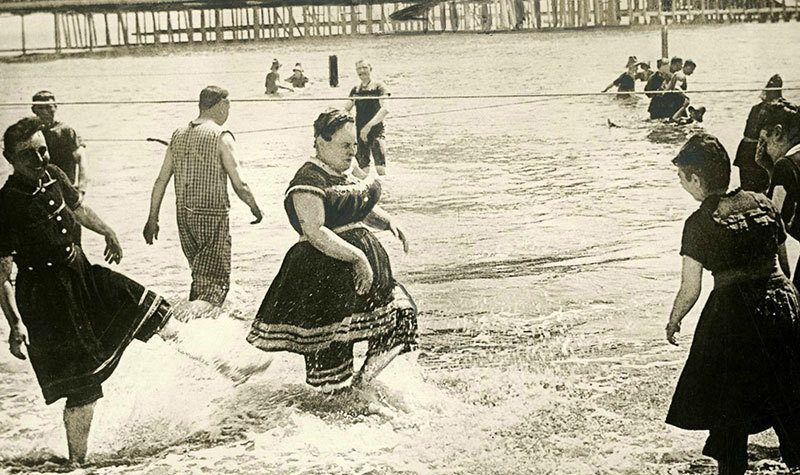
Snapshot from an American seaside resort, c.1890

Women bathing at the seaside, Quebec, Canada, 1870.
Swimsuits
Have you considered why in English we use the term bathing suit? Before Europeans regularly swam in the ocean, they would go to baths for the perceived health benefits. This tradition dates back to Roman and Greek times. The earliest bathing suits were developed for this purpose. Most people could not swim, so instead of submerging themselves in the water, they were wading or being dunked into the waves. So the focus was more on modesty and covering the body than on exercise or free, easy movement.
With that in mind, the bathing suits for women in nineteenth century Europe and the United States were heavy, voluminous affairs. Until the 1890s, a double suit was most common. It was made of two parts with a gown that went from shoulders to knees and trousers that covered the legs down to the ankles. Men’s swimwear generally consisted of a one-piece romper type garment. It was only in the 1890s that form-fitting swimsuits were developed though they were still made of wool, a far cry from the synthetic fibers used in most swimsuits today. Despite the full-coverage swimsuits, many public beaches were sex segregated until the 1900s or as late as the 1940s in Australia.

Oh! And don’t forget socks! Many swimsuits were worn with wool socks or stockings through the 1920s.

Bathers in Jamestown, Virginia, 1897.
Bathing Machines
So how would women change from their corseted and bustled selves to the voluminous swimsuits of the time? There was a machine for that! While the name brings to mind something mechanical, a bathing machine was a wheeled cart that was rolled onto the beach. It had high walls and a roof that allowed the bather to change without being viewed. (Remember modesty!)
Stationary bathing boxes were developed at the same time and filled a similar function. Bathing boxes still exist at some beaches today, particularly in Australia. Some bathing machines would have an entrance on the sand and an exit with steps into the water.

Woman exiting a bathing machine in a bathing suit, Schleswig-Holstein, Germany, 1893.
Dippers and Bathers
This meant that two different jobs were created: bathers and dippers. These people were employed to carry bathers from the beach to the waves. Alternatively, they would move the bathing machine into and out of the water for the beach goer. The job required strength and skill for both the female dippers and male bathers. Some beaches asked the wading visitors to carry a little flag which they could raise in order to be fetched by their dipper or bather. Martha Gunn of Brighton Beach, England became famous at the time for being a favorite dipper of King George IV while he was still Prince of Wales. Her gravestone reads, “Peculiarly distinguished as a bather in this town nearly 70 years.”

A professional dipper (French: baigneur) is holding a woman, preparing to lower her once more in the next wave, Boulogne-sur-Mer, France, July 1843.
Sea Baths and Floating Baths
In the late nineteenth and early twentieth centuries, there were also sea baths or floating baths that could be used by swimmers. These functioned more similarly to swimming pools or medicinal baths. Essentially floating pools at the beach or in a river, sea baths were surrounded by flotillas or piers that contained sex-segregated dressing rooms and pools, and many bathers went in the nude.

Interior of Floating Bath in the Hudson River, New York City, Harper’s Weekly, August 20, 1870.
What do you think of these early bathing inventions? Would you like to try a nineteenth-century bathing suit? Let us know!
Interested in learning more about the first modern Olympics and the rise of sportswear fashion? Check out 1890s Unboxed launching November/December 2025!